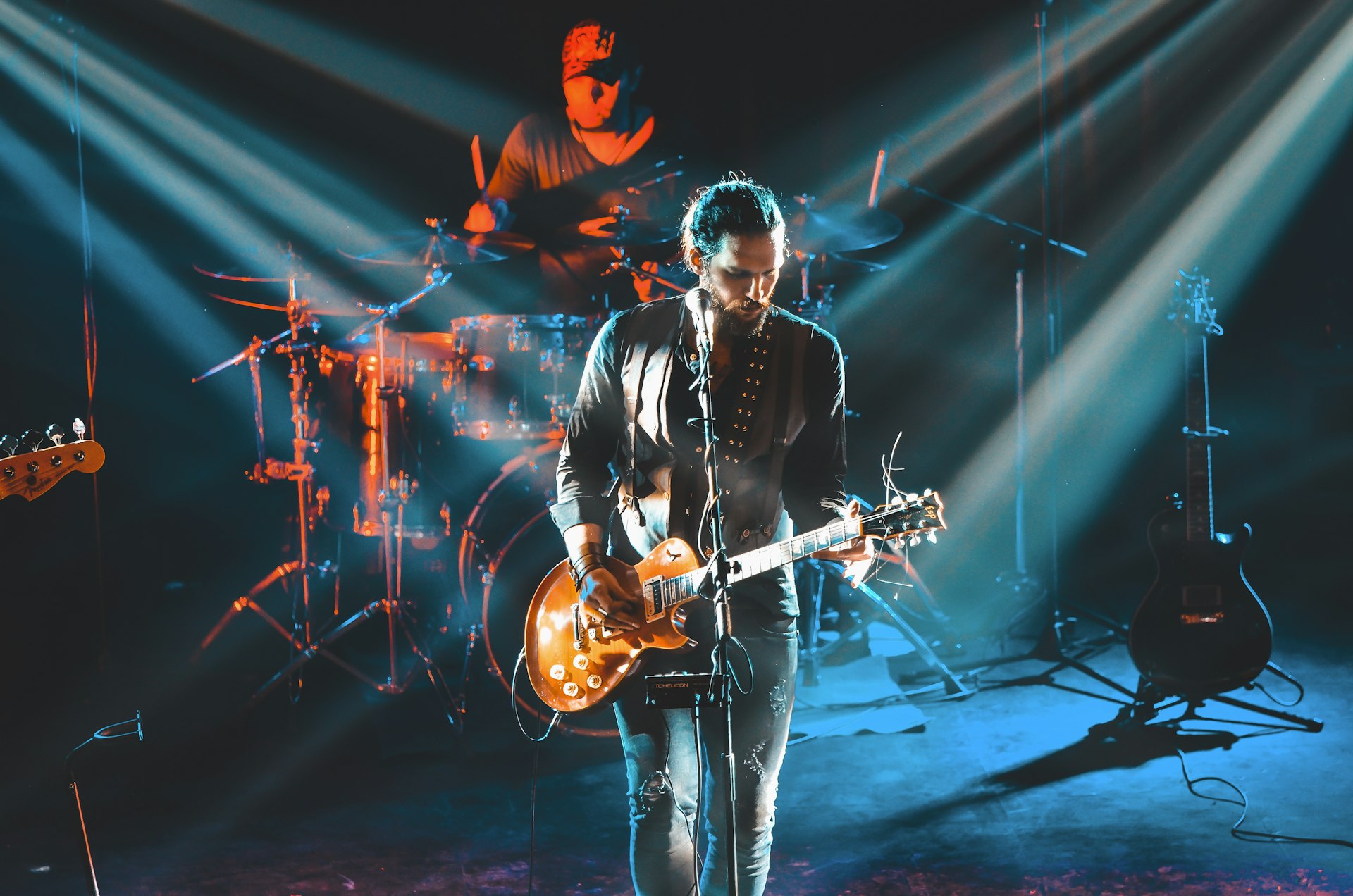

Ben Klock — Berghain NYE Marathon
Silvester Klubnacht · December 31 – January 2+ · Berghain, Berlin, Germany
⚡ The Silvester Klubnacht Experience
The most coveted ticket in global clubbing — Berghain on New Year's Eve
There is no event in electronic music that carries the mythic weight of Berghain's Silvester Klubnacht. Every year on December 31, the former East German power station on the banks of the Spree in Berlin's Friedrichshain district opens its heavy steel doors for a party that will not end until January 2 — or later. For 36 to 48 continuous hours, the world's most revered techno temple operates without pause, and at the center of this marathon stands one man who has come to define everything Berghain represents: Ben Klock.
The Silvester Klubnacht is not a festival. It is not a concert. It is not a typical club night. It is a ritual — an annual pilgrimage for the global techno community. Thousands travel to Berlin from every corner of the world for this single event, knowing that gaining entry is never guaranteed. Berghain's famously selective door policy, overseen by the tattooed photographer and bouncer Sven Marquardt, applies with full force on New Year's Eve. Tickets sell out in seconds. The queue stretches for hundreds of meters in the freezing Berlin winter. And even with a ticket in hand, many are turned away at the door with no explanation given.
For those who make it inside, the experience is transformative. You enter through a dark corridor that opens into the cavernous main hall — an 18-meter-high industrial cathedral of raw concrete, exposed steel, and towering windows that are permanently blacked out. The air is thick with fog. The only illumination comes from sparse, carefully positioned lighting that creates geometric patterns in the haze. There is no VIP area. There is no bottle service. There are no phones — cameras on mobile devices are covered with stickers at the door. You are here for one reason only: the music.
And on New Year's Eve, the music is Ben Klock's. His marathon sets at the Silvester Klubnacht have become the defining expression of what Berghain is — a space where time dissolves, where the outside world ceases to exist, and where the relationship between DJ, sound system, and crowd reaches a state of communion that is simply not possible in a 90-minute festival slot. You do not watch a Ben Klock Berghain marathon. You live inside it.
Midnight itself is almost an afterthought. There is no countdown, no champagne toast, no fireworks visible from inside the windowless concrete shell. Outside, Berlin erupts in pyrotechnics — the city's legendary Silvester celebrations turning the sky into a warzone of color and light. Inside Berghain, nothing changes. The beat continues. The crowd dances. The transition from one year to the next happens not with a bang but with the relentless, hypnotic pulse of a kick drum that has been building for hours and will continue building for hours more. That is the point. That is the philosophy.
🎶 The Marathon Set
8–12+ hours of deep, hypnotic, driving techno — a masterclass in the long form
A Ben Klock Berghain marathon set does not operate like a normal DJ performance. There is no peak-time formula, no obvious build-drop-build structure, no crowd-pleasing anthem dropped at the predictable moment. Instead, Klock treats the extended format as a living, breathing organism — a musical arc that unfolds over eight, ten, twelve or more hours with the patience and intentionality of a composer writing a symphony in real time. Every track is chosen not for its individual impact but for how it serves the journey as a whole.
The set typically begins in deep, minimal territory — sparse percussion, cavernous reverb, sub-bass frequencies that you feel in your chest before you consciously hear them. This is not music designed to immediately excite. It is music designed to draw you in, to create a gravitational pull that makes it impossible to leave the dancefloor. Over the first two or three hours, the textures slowly thicken. Rhythmic elements become more insistent. Melodic fragments emerge and dissolve. The tempo might not change at all — Klock's sets typically hover between 128 and 134 BPM — but the density and intensity increase incrementally, almost imperceptibly.
By hours four through six, the set has entered its driving phase. The kick drums hit harder. The hi-hats slice with greater urgency. Synth stabs and acid lines begin to appear — not as gratuitous effects but as carefully placed punctuation marks in a long, evolving sentence. This is where Klock's track selection from labels like Ostgut Ton, Klockworks, Mote-Evolver, and Prologue becomes most apparent: dark, functional, hypnotic techno built for exactly this purpose.
The final hours are where the transcendence happens. Dancers who have been on the floor for six, eight, ten hours enter a trance-like state that is unique to marathon culture. Fatigue and endurance blend into a heightened awareness. The music becomes the only reality. And Klock, sensing this collective state, pushes the set into its most intense, most powerful, most emotionally devastating territory. The closing hours of a Ben Klock NYE marathon are spoken about in reverent terms by those who have experienced them — a state of euphoria and surrender that cannot be replicated in any other context.
Key Tracks & Signature Selections
Ben Klock — "Subzero"
Released on Ostgut Ton, "Subzero" is perhaps the single track most associated with Ben Klock and the Berghain experience. Its glacial, hypnotic loop and relentless sub-bass were engineered for the club's cavernous acoustics. When this drops at 5 AM on the Berghain floor, it is a moment of pure, devastating power.
Ben Klock — "Compression Session"
A relentless, pounding techno cut that exemplifies Klock's approach to peak-time intensity. "Compression Session" is functional techno at its finest — stripped of all ornamentation, reduced to its purest rhythmic essence. The kind of track that turns a dancefloor into a single, unified organism.
Ben Klock — "Before One"
Klock's debut EP on Ostgut Ton, released in the early years of his Berghain residency. "Before One" established the sonic blueprint that would define his career: deep, patient, architecturally precise techno that rewards sustained attention rather than demanding immediate gratification.
Ben Klock — "Capsule"
Released on his own Klockworks label, "Capsule" represents the deeper, more introspective side of Klock's production. Spacious, atmospheric, and meditative — the kind of track he deploys during the early hours of a marathon set to establish the hypnotic foundation from which everything else builds.
DVS1 — "Black Russian"
A track from Klock's close collaborator and Klockworks artist DVS1 (Zak Khutoretsky). The deep, looping, percussive intensity of "Black Russian" is a staple of Klock's extended sets, representing the Minneapolis-Berlin techno axis that the Klockworks family embodies.
Rödhåd — "Blindfold"
From another Klockworks affiliate, Rödhåd is a Berlin-based producer whose dark, propulsive techno fits perfectly into the Berghain ecosystem. "Blindfold" is the kind of track that appears in the sixth or seventh hour of a Klock marathon — dense, oppressive, and utterly hypnotic.
Shed — "Silent Witness"
René Pawlowitz, recording as Shed, is a core member of the Ostgut Ton family. His productions bridge the gap between dub techno and driving industrial sounds — a sonic palette that is deeply embedded in the Berghain DNA. A frequent feature in Klock's marathon selections.
Ben Klock — unreleased / dubplates
The final hours of a Klock NYE marathon frequently feature unreleased material and dubplates — tracks that exist only in his record bag and may never see official release. This exclusivity is central to Berghain's mystique: you cannot hear this music anywhere else. You had to be there.
🔊 The Sound System & The Room
How Berghain's Funktion-One system and architecture define the marathon experience
The Funktion-One System
Berghain's main hall is equipped with a custom-designed Funktion-One sound system, widely regarded as the finest club sound installation in the world. Designed by Tony Andrews specifically for the room's unique acoustics, the system delivers sound with extraordinary clarity across the entire frequency spectrum. The sub-bass in particular is physical — you feel it in your ribcage, your spine, your bones. For a DJ like Ben Klock, whose music operates heavily in the low-frequency domain, the Funktion-One system does not merely reproduce his music — it transforms it into a bodily experience. The precision of the system means that even the most subtle textural details in a 128 BPM techno track are rendered with crystalline clarity, rewarding the patient, hypnotic approach that defines Klock's style.
The Architecture
Berghain occupies a former thermal power station built in the GDR era, and its main hall retains the raw, industrial character of its origins. The ceiling soars to approximately 18 meters, creating a vast, cathedral-like space that is unlike any other club on earth. The concrete walls, exposed steel beams, and industrial windows (permanently covered) create an acoustic environment that adds natural reverb and depth to the sound. This is not a space that was designed to be a nightclub — it was repurposed, and that repurposing is central to its power. The brutalist architecture strips away comfort and decoration, leaving only the essential elements: space, sound, and bodies in motion. For a marathon set, this raw industrial grandeur creates a sense of timelessness — you could be dancing at 2 AM or 2 PM and the room would feel exactly the same.
The Darkness
Berghain's lighting philosophy is one of radical minimalism. The main floor is kept in near-total darkness for much of the night, with occasional shafts of light cutting through the fog to create abstract patterns on the walls and ceiling. There are no LED screens, no lasers, no pyrotechnics, no visual spectacle of any kind. This is a deliberate artistic choice that forces the focus entirely onto the auditory experience. During a Ben Klock marathon set, the darkness becomes a cocoon — it eliminates visual distraction and allows the listener to become fully immersed in the sound. Combined with the fog that fills the room, the effect is one of sensory reduction: you are alone with the music, even in a room filled with a thousand other people.
The DJ Booth
Berghain's main floor DJ booth is positioned on a raised platform at one end of the hall, giving the DJ a commanding view of the dancefloor. Unlike many modern clubs where the booth is a focal point with screens and spotlights, Berghain's booth is deliberately understated. There is no showmanship expected — no hands-in-the-air moments, no fist-pumping, no interaction with a camera. The DJ is a technician and a guide, not a performer. Ben Klock embodies this philosophy completely. He stands behind the decks with focused intensity, his attention entirely on the music and the room's energy. He reads the crowd not through eye contact and gestures but through the collective vibration of bodies responding to sound.
🌐 The Culture of Berghain NYE
No phones, no countdowns, no compromise — the purest expression of club culture
The Berghain Silvester Klubnacht is not merely a party — it is a cultural phenomenon that embodies a philosophy about what nightlife can and should be. Every aspect of the experience is designed to strip away the superficialities of modern clubbing and return to something essential: the relationship between music, space, and the human body in motion.
The no-phone policy is the most visible expression of this philosophy. When you enter Berghain, your phone's camera is covered with a sticker. Photography and video recording are prohibited. In an age where every experience is documented, shared, and commodified, Berghain demands that you be present. There is no Instagram story of a Ben Klock NYE marathon. There is no TikTok clip of the moment the bass dropped at 4 AM. The experience exists only in the memories of those who were there, and this ephemerality is precisely what makes it so precious.
The cash-only policy (which has been a long-standing tradition at the club) reinforces the sense of existing outside the normal rules. There is no digital trail. The transactions at the bars — where drinks are famously inexpensive by Western European standards — are anonymous and immediate. Everything about Berghain is designed to create a space apart, a temporary autonomous zone where the conventions of everyday life do not apply.
The queue is itself a ritual. On New Year's Eve, the line to enter Berghain can stretch for hours in the bitter Berlin winter. People stand in silence, in the cold, waiting for their moment before Sven Marquardt and the door team. There is no logic to who gets in and who does not — or rather, the logic is opaque and subjective. You dress in dark, understated clothing. You do not arrive in a large, boisterous group. You do not plead or negotiate. You approach the door, and you are either in or you are not. This ruthless selectivity is not elitism for its own sake; it is a curatorial act. Berghain is curating its crowd with the same care that Ben Klock curates his tracklist.
Dancing through midnight without acknowledgment is perhaps the most potent symbol of the Berghain NYE experience. In every other context — every house party, every bar, every festival, every city square on earth — the transition from December 31 to January 1 is marked with ritual: countdowns, kisses, fireworks, champagne. At Berghain, there is nothing. The beat does not stop. The DJ does not pause. There is no announcement. The new year arrives, and the music continues as if time itself is irrelevant. For many who experience this, it is a profoundly moving moment — a physical demonstration that the dancefloor exists outside of ordinary time, that the collective experience of music and movement transcends the arbitrary markers of the calendar.
Ben Klock represents the purest form of DJ residency in modern electronic music. While other DJs of his stature tour the world, playing festival stages and superclubs on different continents every weekend, Klock's identity remains inseparable from Berghain. He is not merely a DJ who plays at Berghain; he is Berghain, in the same way that Berghain is an extension of him. His commitment to a single room, a single sound system, and a single community over two decades represents a counter-narrative to the globalized, content-driven DJ career. He proves that depth — the depth of knowing a room, knowing a system, knowing a crowd — is more powerful than breadth.
👤 About Ben Klock
Berghain's defining resident — two decades of devotion to a single dancefloor
Ben Klock (born 1972 in Berlin, Germany) is one of the most respected and influential techno DJs and producers in the world. He has been a resident DJ at Berghain since the club's opening in 2004, making him one of the longest-serving and most iconic residents in the venue's history. His name is virtually synonymous with the Berghain sound — deep, hypnotic, driving techno that prioritizes atmosphere, tension, and physical intensity over melody or spectacle.
Klock grew up in West Berlin during the Cold War era and came of age during the explosive birth of Berlin's techno scene following the fall of the Wall in 1989. He was shaped by the city's unique cultural environment — the abandoned industrial spaces, the spirit of creative anarchy, the collision of East and West that produced one of the most important musical movements of the late 20th century. Before Berghain, he was a regular at its predecessor, Ostgut, which operated from 1998 to 2003 in a different location near the Ostbahnhof.
In 2006, Klock founded Klockworks, his own record label that has become one of the most respected imprints in techno. The label's catalog is a masterclass in functional, dancefloor-focused techno, featuring releases from Klock himself alongside artists including DVS1 (the Minneapolis-based DJ and producer Zak Khutoretsky), Trevino (Marcus Sherbourne from London), and Rödhåd (the Berlin-based DJ and Dystopian label founder). Klockworks releases are characterized by their precision, restraint, and absolute commitment to the dancefloor.
Klock's own productions are released primarily on Ostgut Ton, Berghain's in-house label, and on Klockworks. Key releases include "Subzero," "Compression Session," and his debut EP "Before One." His approach to production mirrors his approach to DJing: patient, meticulous, and focused on creating maximum impact through minimum ornamentation. His mix CDs and podcasts — particularly his contributions to the Berghain mix series on Ostgut Ton — are considered essential listening for anyone seeking to understand modern techno.
Beyond Berghain, Klock is a regular headliner at the world's most prestigious techno events. He has delivered landmark performances at Dekmantel in Amsterdam, Awakenings in the Netherlands, Fabric in London (where his appearances were legendary), Movement in Detroit, and Sónar in Barcelona. His back-to-back sets with Marcel Dettmann — his fellow Berghain resident and closest musical collaborator — are among the most celebrated performances in contemporary techno, representing the telepathic connection between two DJs who have spent decades sharing the same booth and the same dancefloor.
Yet for all his global touring, Klock always returns to Berghain. His residency is not a contractual obligation but a spiritual commitment. He has repeatedly stated in interviews that Berghain is where he feels most at home, where the sound system, the room, and the crowd allow him to express his art at its highest level. In an industry that rewards constant movement and global brand-building, Ben Klock represents something increasingly rare: a DJ who found his room and devoted his life to it.
❓ Frequently Asked Questions
Everything you want to know about Ben Klock's Berghain NYE marathon and the Silvester Klubnacht